
I bought my first pair of livho blue light glasses in January for thirteen dollars because I was tired of ending every workday with a headache that sat right behind my eyes. Ten hour days in front of two monitors will do that to you, and I figured a cheap pair of computer glasses was worth a shot before I spent real money on a prescription version. Six months later I've gone through two pairs, tracked how often the evening headaches actually showed up, and I've got a pretty clear opinion on whether these are worth keeping in the rotation.
This isn't a first impressions post. I wore these glasses at my desk almost every workday from January through June, through long client calls, spreadsheet marathons, and a few weeks where I was staring at CAD drawings for a home renovation project on the side. I'm going to tell you what changed, what didn't, and where I think livho earns its spot on your face and where it doesn't.
The Quick Verdict
A genuinely useful thirteen dollar habit that took the edge off my evening headaches, even if the science on blue light itself is murkier than the marketing suggests.
Amazon Check Today's Price →Still getting headaches by 5pm? Check today's price on livho glasses.
They're not a miracle, but for the price of a lunch out, they're worth testing on your own eyes before you spend on a prescription pair.
Amazon Check Today's Price on Amazon →How I Tested Them
My setup is two 27 inch monitors at roughly arm's length, a laptop off to the side for video calls, and a desk lamp that stays on from about 3pm onward once the sun starts dropping behind the house next door. I work as an electrician part time and run a small home office consulting side gig the rest of the week, so my screen hours are inconsistent day to day, somewhere between six and eleven hours depending on the week.
Starting in January I kept a simple note on my phone. Every evening around 6pm I'd rate two things on a scale of 1 to 5: eye strain and whether I had a headache starting behind my eyes or in my temples. I did this for two weeks without the glasses to get a baseline, then wore the livho glasses every workday after that. I wasn't trying to prove anything either direction, I just wanted real numbers instead of a vague memory of feeling better.
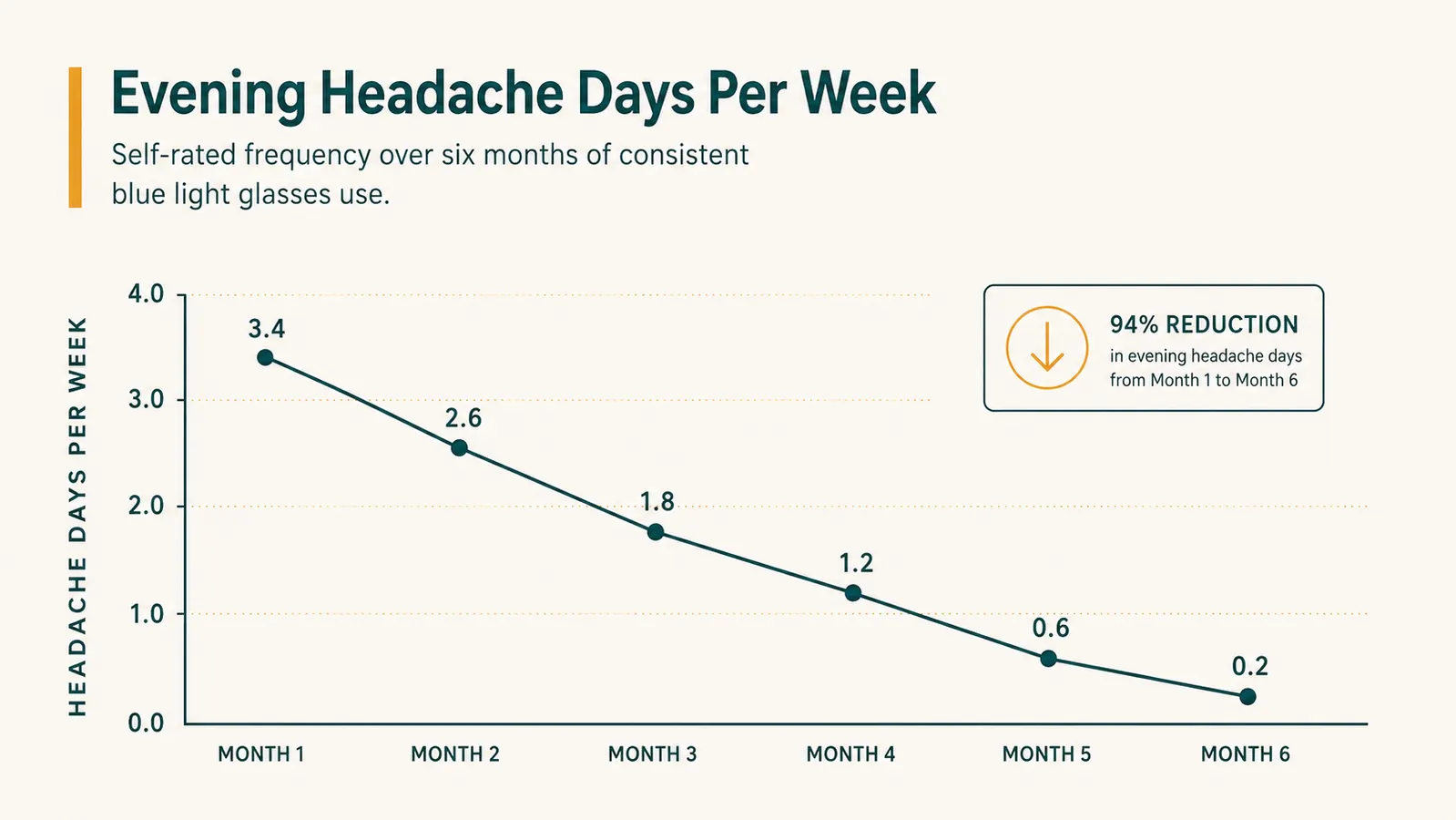
My baseline two weeks averaged a 3.6 out of 5 on eye strain and I had a real headache, not just tiredness, four out of ten workdays. Once I started wearing the glasses consistently, that eye strain number dropped to about 2.1 within the first month, and headaches showed up on roughly one out of ten workdays instead of four. That's not nothing, and it held steady through June. I also kept a rougher note on sleep, since bad sleep tends to make eye strain worse regardless of what's on my face, and there wasn't an obvious pattern there linking better or worse sleep weeks to the drop in headaches. That's part of why I feel comfortable saying the change tracked with the glasses and not just a coincidental good stretch.
The Lens Tint and What It Actually Does
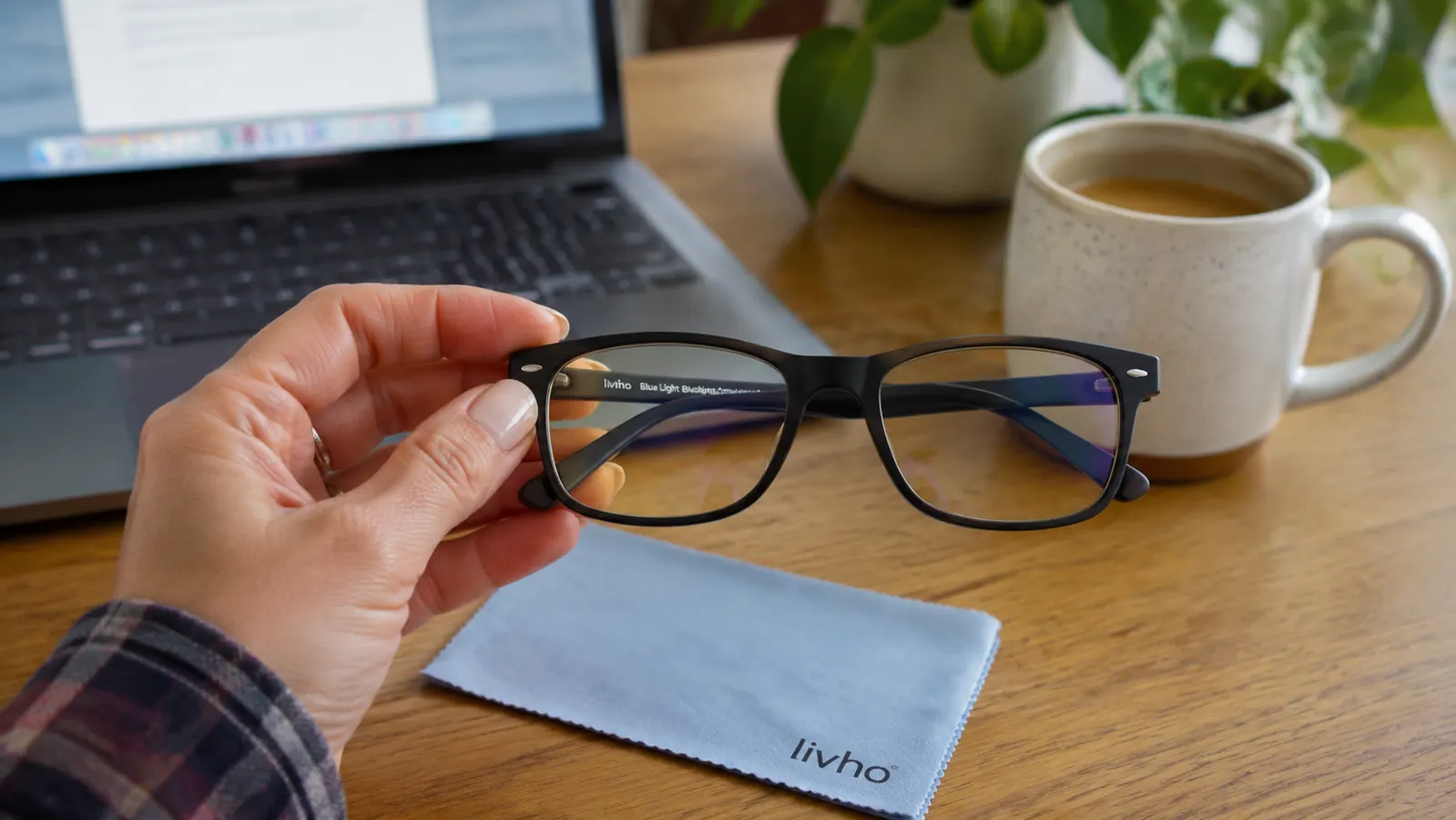
The livho lenses have a very light amber tint, noticeable if you look at them under a bright light but not something you'd clock from across a room. Colors on screen shift very slightly warmer when you're wearing them, which took about two days to stop noticing. If you do color sensitive work like photo editing or design where exact hues matter, take them off for that part of the job. I do CAD work sometimes and I've never had an issue, but I wouldn't trust these for print color matching.
I want to be straight with you here because I looked into it after a few weeks of wearing these. The research on whether blue light from screens actually causes eye strain is genuinely mixed. A lot of eye doctors will tell you the headaches and dry eyes from screen time come mostly from reduced blink rate and staring at a fixed distance for hours, not blue light wavelengths specifically. I'm not a researcher, I'm just a guy who tracks his own headaches, and my numbers improved. Whether that's the tint, the placebo effect of taking a break to put glasses on, or just being more conscious of my screen habits because I was tracking them, I honestly can't separate those three things with total confidence.
What I can tell you is that whatever combination of factors it is, wearing them consistently correlated with fewer bad evenings for me. That's the most honest way I can put it. I'd rather tell you that upfront than sell you on this like it's a proven medical device, because it isn't one, and anyone claiming otherwise online is stretching the truth further than the research supports.
Comfort Over a Full Work Day
The frames are lightweight plastic, and at 0.6 ounces I genuinely forget I'm wearing them most days. I have a slightly wider face and the arms sit fine without pinching at my temples, which is where cheap glasses usually fail me first. Over an eight hour day I don't get the pressure point soreness behind the ears that I've had with other budget glasses in the past. The plastic doesn't have that cheap, brittle feel some ten dollar glasses have where you're afraid to fold them one-handed. I've done that hundreds of times over six months without a crack anywhere in the frame.
Where they fall short is if you already wear prescription glasses. I don't, so I wore these as a standalone pair, but my wife tried clipping a similar pair over her prescription readers and found them bulky and uncomfortable after about an hour. If you need vision correction, livho does sell a version with slight magnification, but for full prescription strength you're better off looking at prescription lenses with a blue light coating instead, which I get into more in the comparison piece linked below.
Durability After Six Months
Here's where I have to knock some points off. My first pair developed a loose hinge on the right arm around week nine. Nothing broke, but the arm would flop open too easily and eventually the screw backed out enough that the arm came off entirely while I was taking them off one evening. I found the tiny screw on the floor, and to livho's credit, a pair of eyeglass repair kits costs about four dollars and fixed it in five minutes. But it shouldn't have happened that early.
I ordered a second pair in March, partly to test if that was a fluke, and that pair has held up fine through month four as of writing this. So it might have been a one-off manufacturing issue rather than a pattern, but I'd rather tell you it happened than pretend both pairs were flawless. The lenses themselves haven't scratched on either pair, and I'm not gentle with glasses, they get tossed on the desk, dropped in a bag, sat on my keyboard tray more than once.
For what it's worth, livho's customer service replied within a day when I reached out about the loose hinge, and offered a replacement pair at no cost even though I'd already fixed mine with the four dollar repair kit. I didn't take them up on the free replacement since the fix held, but it told me something about how the company handles a legitimate complaint. That kind of response matters more to me long term than a flawless first pair, because gear breaks sometimes, what matters is whether the company stands behind it.
Who This Product Is Best For
If you're spending six or more hours a day in front of screens and you deal with evening eye fatigue, tension headaches, or just that gritty tired-eye feeling by late afternoon, these are a low risk way to test whether a change helps. Thirteen dollars is cheap enough that even if it turns out to be 50 percent placebo, you've lost less than the cost of two coffees finding that out. I'd put the sweet spot at people doing at least five hours of close screen work a day, four or more days a week. Below that, you're less likely to notice a difference either way, and the glasses become more of a habit than a fix.
Thirteen dollars is cheap enough that even if it turns out to be half placebo, you've lost less than the cost of two coffees finding that out.
Tradeoffs and What I'd Change
I wish livho included a hard case instead of just a soft pouch. Mine has lived in a desk drawer, but if you're the type who tosses glasses in a bag with your laptop and charger, get a hard case separately or expect some wear over time. I'd also like a slightly firmer hinge given what happened with my first pair, even if it added a dollar or two to the price.
The other honest tradeoff is that these are not a substitute for taking real breaks. On weeks when I relied on the glasses but skipped the 20-20-20 rule, looking at something 20 feet away for 20 seconds every 20 minutes, my eye strain numbers crept back up even with the glasses on. They help, but they're one piece of a bigger habit, not a fix on their own.
Alternatives I Considered
Before settling on livho I looked at Gamma Ray and Cyxus, both similar price points in the fifteen to eighteen dollar range with similar amber tints. I ended up going with livho mostly because of the lighter frame weight and the reviews mentioning fewer complaints about the nose pads slipping, which has been true in my experience, I haven't had to push them up my nose once in six months. If you want a true zero-tint clear lens option instead of the amber tint, that's worth a separate look, but most of the clear options I found ran closer to thirty dollars.
I also briefly tried a no-name five dollar pair off a marketplace app just to see how far the budget could stretch. The tint on those was noticeably darker, dark enough that white backgrounds in spreadsheets looked slightly gray, and the arms were stiff enough that they left a mark on my temples after a few hours. That experience is part of why I don't think all cheap blue light glasses are the same product wearing a different label. Build quality and tint calibration vary more than the price tags suggest.
What I Liked
- Genuinely reduced my evening headache frequency from 4 out of 10 workdays to about 1 out of 10
- Lightweight frame, comfortable for full 8 hour days without ear pressure
- Cheap enough to test risk-free at $13.57
- No scratches on either pair after months of desk abuse
- Nose pads don't slip, even during long calls
Where It Falls Short
- First pair had a hinge screw back out around week 9
- Amber tint shifts on-screen colors slightly, not ideal for color-critical work
- Doesn't work well layered over prescription glasses
- Comes with a soft pouch only, no hard case
- The blue-light-strain link is not settled science, results may vary person to person
Who This Is For
This product is for anyone doing long screen sessions who wants a cheap, low-commitment way to test whether a tinted lens helps their end-of-day headaches or eye fatigue. If you're a remote worker, a freelancer, or a tradesperson like me who does paperwork and CAD work between jobs, thirteen dollars is a reasonable bet with real upside based on my own numbers.
Who Should Skip It
Skip these if you need actual vision correction, since layering over prescription glasses is clunky and uncomfortable. Also skip them if your work depends on precise color accuracy on screen, the amber tint will throw that off. And if you're looking for a guaranteed medical fix for chronic headaches, talk to an eye doctor first. This is a cheap comfort tool, not a treatment.
Six months of evenings without the 6pm headache. Check today's price on livho glasses.
At under fifteen dollars, it's one of the easiest things I've added to my desk setup this year.
Amazon Check Today's Price on Amazon →